DRY HEARTH MELTING FURNACES
GM-D SERIES
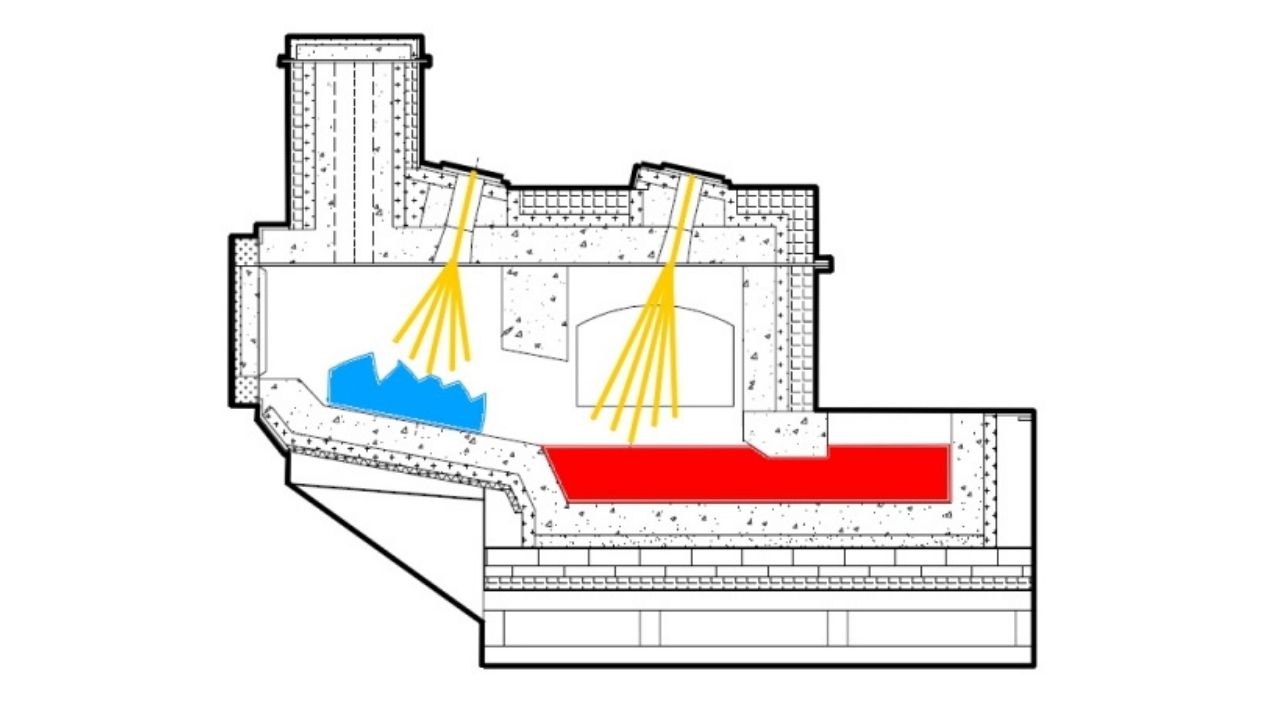
The GM-D Series is a gas-fired aluminum dry hearth melting furnace with a separate dry charging chamber and molten-metal holding bath. Charge melts on an angled hearth before flowing into the bath, avoiding direct immersion of cold feed. Separate burners and controls serve the melting and holding zones. This dry hearth melter is specified around suitable feedstock, melt rate, holding demand, metal-quality goals and the casting or transfer layout.
TECHNICAL OVERVIEW
A dry hearth, sometimes called a dry sole, is a sloped refractory charging surface rather than a pool of molten metal. In the GM-D aluminum dry sole furnace, suitable ingots and clean prepared returns heat and melt on the sloping dry hearth before liquid aluminum drains toward the holding bath. This aluminum dry sole melting furnace arrangement can help keep oxide skins and some solid residues on the hearth for removal instead of carrying them directly into the bath. Feed preparation, hearth cleaning and operating practice remain essential to high metal purity.
The dry charge zone separates incoming solid aluminum from the molten holding bath, which can reduce bath-temperature disturbance and help limit oxide entrainment. It does not make wet, oily or incompatible scrap safe to charge. Assess alloy, material size, moisture, coatings and contamination before use. The sloped refractory hearth supports oxide skin separation because molten aluminum drains away while some oxide skins remain on the hearth; the actual cleanliness and low metal loss depend on feed condition, temperature and cleaning practice.
The GM-D is an aluminum melting and holding dry hearth furnace with separate melting and holding chambers. Its two burners, two blowers and independent heating systems support two-zone temperature control, allowing the melt path and holding bath to be managed for their different duties. The large rear charging door, side maintenance access, PLC/HMI controls and insulated refractory construction support planned operation and cleaning. Compare the required melt rate, holding reserve, charge geometry and access clearances before selecting a size.


ADVANTAGES OF DRY HEARTH
Safety and Efficiency.
The dry hearth charging chamber has no molten metal in it thus it reduces the dangers of metal splash. In addition, this design prevents temperature drop caused by the addition of cold ingots or scrap to the metal bath. The charging chamber is angled down and as the metal melts it runs into the metal bath. Less drop in temperature, means a more consistent temperature, which translates to better quality castings and less scrap.
TWO CHAMBERS
Separate Melting and Holding Chambers.
GM-D has separate melting and holding chambers, each with its own burner, air blower and heating system. This supports independent melting and holding temperature control: charge can melt on the dry hearth while the bath is managed for downstream casting demand. The arrangement can reduce temperature swings from charging, but alloy, feed rate, maintenance and operating practice still determine the result. GM-D is especially relevant for suitable ingots and clean prepared returns.
HIGHEST RETURN ON INVESTMENT
We Give You More Furnace for Your Money.
To be competitive today’s economy requires that manufacturers run their operations more efficiently and cost effectively than ever before. We offer the highest ROI (return on investment) in the industry. Dynamo gives you high-quality products for a reasonable investment and with more features than any other company. Simply put, we give you the most for your money!
CHOOSE YOUR CONTROL SYSTEM
We Give You Options of PLC & HMI.
Select the control system that is best for you and easiest for your maintenance team.
EASY TO OPERATE INTERFACE
Greater Control - Means Greater Efficiency.
The GM-D Series dry hearth melting furnaces feature state-of-the-art PLC control with large color HMI screens with easy to read graphics - all at no extra charge. See in real time all furnace functions and change any setting on the fly. Now that's control.
DUAL AIR BLOWERS
Two are Better Than One.
Using double air blowers gives us more flexibility and precision in the amount of air available for the melting and holding chambers at any given time. When balanced correctly they increase the efficiency of the furnace and reduce running costs.
VFD DRIVE BLOWER MOTORS
Better Efficiency and Lower Operating Cost.
Lots of air without control wastes a significant amount of energy. We use VFD Drives combined with Premium Inverter Duty Motors to give you greater RPM only when it is needed. All this translates into greater efficiency, lower operating costs, quieter operation, soft start and longer motor life. The advantage is clear. This is just one of the many ways we use to increase furnace efficiency, and reduce long term operating costs.
HIGH QUALITY COMPONENTS
We Use Brand Name Components You Know and Already Use.
We use only the finest quality components that are open source and readily available locally in your area, or from our online parts store.
LARGE SIDE CLEANOUT DOOR
Easy Access to the Entire Interior of the Furnace with no Dead Spots.
The key to long furnace service lifetime is regular cleaning. However, cleaning is hard through a small maintenance door. We have made our side cleanout door extra wide to facilitate and encourage easy, regular cleaning.
CERAMIC ALUMINUM DROSS FILTRATION
Comes Standard with All Models and Keeps Your Aluminum Clean.
Our ceramic foam filter can effectively remove and absorb large or small impurities in molten aluminum, improves the surface quality, and microstructure effectiveness. Thermal shock resistance, this ceramic filter improves purity and improves erosion resistance molten aluminum.
ELECTRIC CHARGING DOOR
Simplfy and Speed Up Charging the Furnace.
Our standard door is a manual hinged. However, you can add this electric drive charging door to increase speed and productivity.
REMOTE SERVICE
We Can Remotely Troubleshoot Your Furnace from Our Facility.
Our GM-D Series dry hearth melting furnace includes a Remote Connectivity Unit which allows our furnace technicians to remotely check the performance of the furnace, make any needed changes to the program or HMI, or to troubleshoot it directly from our service center. The customer is only required to connect the unit to the Internet via an Ethernet cable. We handle the rest.
INDUSTRY 4.0 REMOTE MONITORING
Remotely Monitor Your Furnace Performance From Any Device.
As an option, all our furnaces are available with Industry 4.0 remote performance monitoring units which feature a custom dashboard. You can not only monitor furnace performance, but you can be notified before an issue occurs. Included are condition based maintenance reminders and shift performance statistics. Minimize impact of emergencies and maximize furnace uptime, and productivity. See what is going on with the furnace and your production from any device, anywhere in the world.
SIX STANDARD SIZES
Flexible Range of Applications.
Available from a melting rate of 330 lbs to 1650 lbs per hour, the GM-D Series dry hearth melting furnaces allow for a wide range of applications.
| Standard | US / Imperial (Al) | Metric (Al) | ||
| Model | Holding | Melting/h * | Holding | Melting/h * |
| GM-D-1100 | 1100 lb | 330 lb | 500 kg | 150 kg |
| GM-D-1760 | 1760 lb | 550 lb | 800 kg | 250 kg |
| GM-D-2200 | 2200 lb | 660 lb | 1000 kg | 300 kg |
| GM-D-2600 | 2600 lb | 880 lb | 1200 kg | 400 kg |
| GM-D-3300 | 3300 lb | 1100 lb | 1500 kg | 500 kg |
| GM-D-4400 | 4400 lb | 1650 lb | 2000 kg | 750 kg |
Applications For The GM-D Series Aluminum Dry Hearth Melting Furnace
GM-D keeps the charging hearth free of a standing molten bath, reducing direct splash exposure when suitable dry material is loaded. This is a safety advantage, not a guarantee against splashing or reactions: charge must be dry, inspected and handled under the plant’s hot-metal procedure. As metal melts on the sloped hearth, it drains toward the holding bath with less direct bath disturbance.
The dry hearth can accommodate suitably sized ingots and prepared bulky returns that fit the charging door and hearth. It is not a substitute for removing moisture, oil, incompatible alloys or hazardous contaminants from scrap. Evaluate charge geometry, cleaning needs, oxide carryover and measured metal recovery before claiming low metal loss for a specific feed mix.
A dry hearth furnace for die casting can combine melting with a separately controlled holding bath. For a casting station dry hearth furnace, confirm that the footprint, melt rate, holding reserve and discharge route fit the individual cell; larger installations may instead serve several lines. GM-E remains the compact mini-stack option for in-cell melting. Compare these arrangements in the die-casting foundry application guide.
With its stable molten bath and controlled melting environment, the GM‑D Series is well‑suited for alloy preparation and melt treatment. Operators can add alloying elements, perform degassing, and maintain precise temperature control before transferring metal to casting equipment. The gradual melting process on the hearth reduces oxide formation and improves alloy uniformity. This makes the GM‑D Series an excellent choice for producing high‑performance aluminum alloys used in automotive, aerospace, and industrial applications where metallurgical consistency is critical.
The GM‑D Series is designed for facilities focused on reducing fuel consumption and improving operational efficiency. Its closed‑door melting process minimizes heat loss, while the angled hearth design ensures efficient heat transfer to the charge. Because cold material is not added directly into the molten bath, the furnace avoids the temperature drops that typically increase fuel usage in conventional systems. Combined with thick insulation, high‑quality refractory lining, and PLC‑optimized burner control, the GM‑D Series delivers lower operating costs and improved energy efficiency.
The sloped hearth lets molten aluminum drain toward the holding zone while some oxide skins and unmelted residues can remain on the hearth for removal. This oxide skin separation can support high metal purity, but it does not replace skimming, alloy control or melt-quality testing. Plan the transfer point and holding temperature so clean metal reaches the casting process without unnecessary turbulence.
The GM‑D Series is engineered for continuous operation, making it ideal for plants that run extended production cycles. Its heavy‑duty refractory lining, robust steel shell, and PLC‑controlled burner system ensure stable performance with minimal maintenance interruptions. The furnace’s ability to maintain consistent melt quality over long periods enhances overall process stability and production efficiency. This reliability is especially valuable for automotive casting plants, large foundries, and high‑volume aluminum processors.
Foundries with multiple casting lines often require a centralized melting system capable of feeding several processes simultaneously. The GM‑D Series provides the melting capacity, holding stability, and automation needed to serve multiple ladle‑pouring stations or casting machines. Optional metal‑handling accessories — such as tap‑out spouts, launders, and transfer systems — allow seamless integration into complex production layouts. This makes the GM‑D Series a versatile solution for facilities seeking centralized melt management with high efficiency and clean metal output.
Frequently Asked Questions About The GM-D Series Aluminum Dry Hearth Melting Furnace
The GM-D separates solid charge from the holding bath. Its sloped dry hearth can reduce direct splash exposure during charging and limit bath-temperature disturbance as the metal melts and drains. These are risk-reduction features, not permission to charge wet or contaminated material. Separate heating for melting and holding also supports two-zone temperature control.
GM-D is especially suited to dry aluminum ingots and compatible clean prepared returns that fit the hearth and charging door. Other bulky feed must be reviewed for alloy, size, moisture, coatings and contamination. Never assume a dry hearth makes wet or oily charge safe; the furnace configuration and feed preparation must be checked before operation.
Aluminum melts on the angled dry hearth before draining to the holding bath. Some oxide skins and solid residues can stay on the hearth for removal, reducing their direct transfer into the bath. Along with appropriate skimming, charge preparation and independent zone control, that process can support high metal purity and lower melt loss. Actual results depend on the feed mix and operating practice, not on a universal guaranteed recovery percentage.
Yes — the GM‑D Series is designed for continuous, high‑volume aluminum melting. Its dual‑burner configuration (melting and holding) ensures stable temperature control throughout long production cycles. Because charging does not disturb the molten bath, the furnace maintains consistent melt conditions even during frequent loading. This makes the GM‑D Series ideal for die‑casting plants, gravity casting lines, and foundries that require a reliable, uninterrupted supply of molten aluminum. Its durable refractory lining and PLC‑based control system support long operating life with minimal downtime.
Yes — GM‑D Series aluminum dry hearth melting furnaces are available throughout the United States, Canada, and Mexico. Foundries, die‑casting plants, and aluminum processors across North America rely on these furnaces for safer charging, cleaner melt quality, and reduced fuel consumption. Regional availability ensures faster delivery, dependable technical support, and access to replacement parts. Units can be configured with various capacities, burner systems, automation packages, and metal‑handling options to meet specific production requirements.
RELATED PROJECTS & POSTS
Dry-Hearth Aluminum Gas Melting Furnace Design & Assembly Project
Read the process of engineering and assembly of two dry-hearth aluminum gas melting furnaces for a foundry in
Arkansas, USA.
Advantages of a Dry Hearth Furnace Design
Dry-hearth Aluminum Gas Melting Furnace Testing & Pre-Commissioning Project
After the completion of two dry-hearth furnaces and before shipment, our engineers run numerous tests and pre-commissioning operations to ensure the flawless quality is delivered to our customer in Arkansas, USA.
Energy Efficiency & Environmental Impact of Industrial Furnaces
Explore the technologies, strategies, and operational practices that help facilities reduce energy consumption, comply with environmental regulations, and operate more sustainably.
Industrial Furnace Types Guide: A Buyer’s Handbook
Read our guide on selecting the right Industrial furnace type to learn about the major furnace categories used across industry, how each system works, where it excels, and how to evaluate it for your operation.
Metal Melting Furnaces: A Complete Technical Guide
Metal melting is one of the most energy‑intensive and technically demanding operations in manufacturing. This guide on metal melting furnaces explores the major furnace technologies used for non‑ferrous melting, explaining how each system works, where it excels, and how to evaluate it for your application.