

Blog
The Physics of Aluminum Chip Recovery: Surface Area, Oxidation, Moisture and Metal Yield

Direct answer: aluminum chips are difficult to recover because they combine high surface area, low bulk density and variable contamination. Thin chips expose far more oxide-forming area per unit metal volume than compact scrap. Water and coolant consume drying energy and create serious process hazards, while oils, fines and entrained nonmetal mass distort apparent yield unless the material balance uses contained metal as its denominator.
All calculations and graphs are reproducible illustrations based on the assumptions shown. They are not test data, performance guarantees, code-compliance calculations or substitutes for project-specific thermal, metallurgical, combustion, structural, electrical or safety engineering.
Nomenclature and Units
| Symbol | Meaning | Unit |
|---|---|---|
| A; V | Chip surface area and solid volume | m²; m³ |
| t; w; l | Characteristic thickness, width and length | mm or m |
| ρ_bulk | Loose bulk density | kg/m³ |
| m_w; m_s | Water and dry-solid mass | kg |
| h_fg | Latent heat of water vaporization | kJ/kg |
| m_feed | Incoming wet feed mass | kg |
| m_metal,feed | Metal contained in feed | kg |
| m_recovered | Recovered liquid/solid metal credited | kg |
| R_m | Contained-metal recovery | % |
Surface-to-Volume Ratio
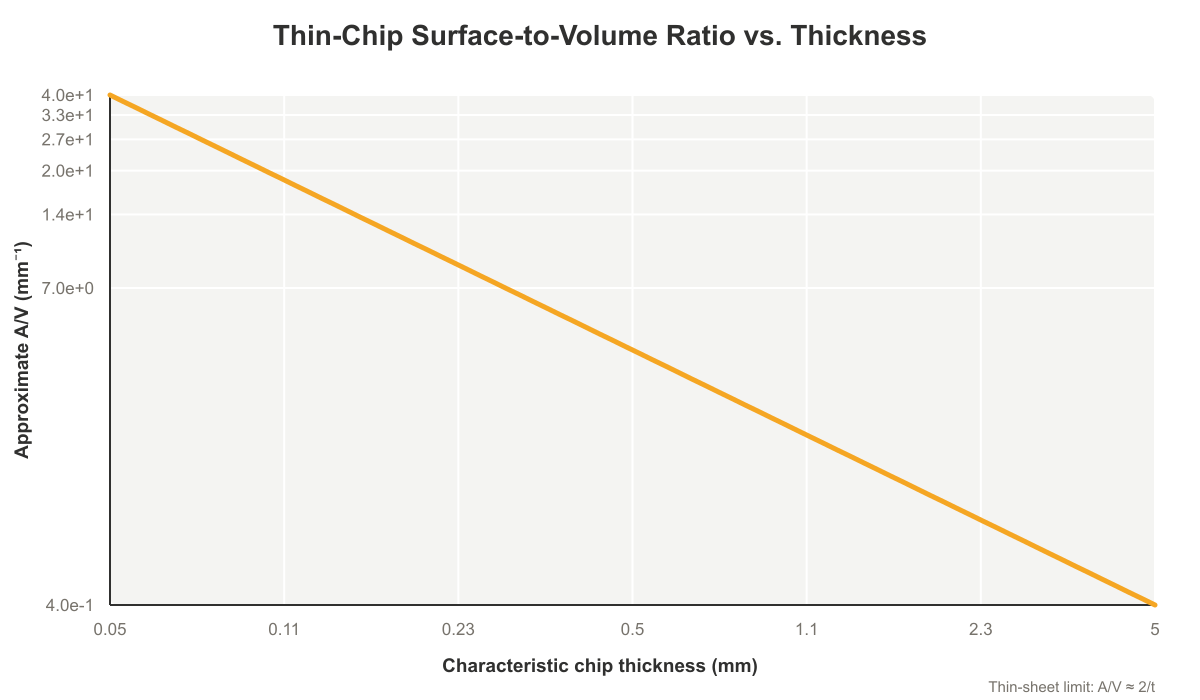
Reducing characteristic thickness from 1.0 mm to 0.1 mm increases this approximate A/V by a factor of ten. Greater exposed area supports more oxide film, adsorbed contamination and rapid heat exchange. Real curled turnings require image or size-distribution measurements; the equation is a geometric scaling argument, not a complete oxidation law.
Figure: Log-log geometric scaling for the thin-chip approximation.
Bulk Density and Charging Volume
One tonne at 150 kg/m³ occupies about 6.7 m³ before compaction, while one tonne at 600 kg/m³ occupies about 1.7 m³. Low density affects bin volume, conveyors, bridging, furnace opening time, submergence and throughput even when the contained metal mass is identical.
Bulk density should be sampled using a documented container volume and filling method because vibration, chip morphology and handling history change the result.
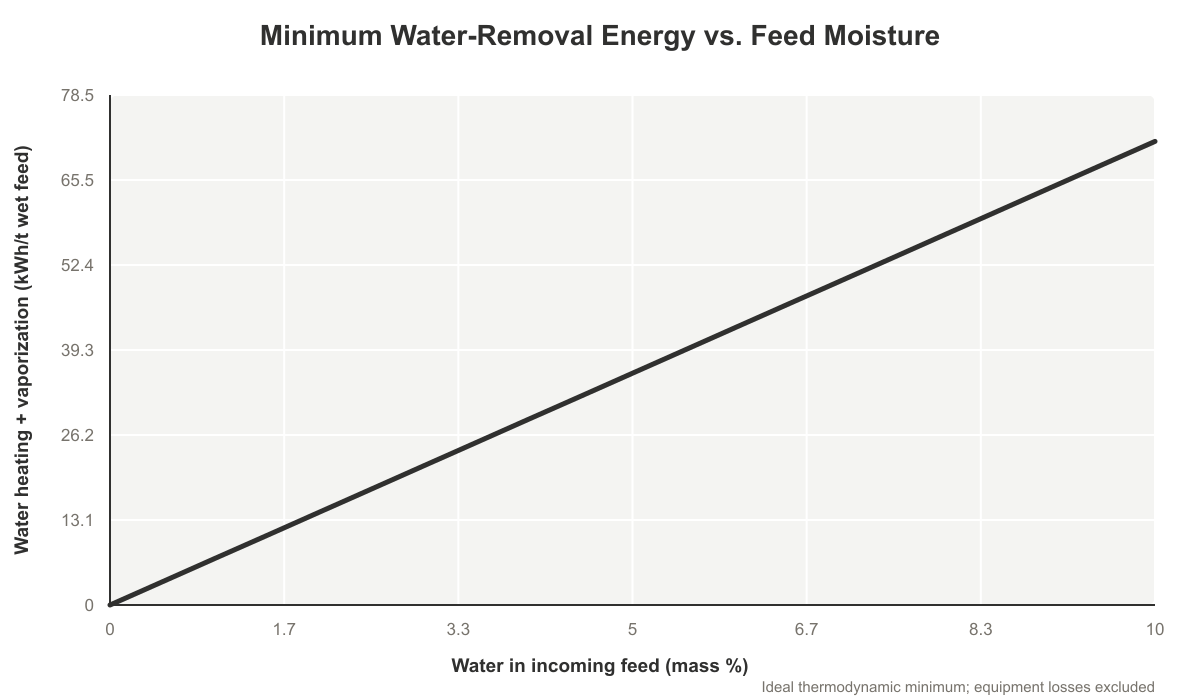
Figure: Ideal heat for water warming and vaporization; equipment losses excluded.
Moisture-Removal Thermodynamics
At 4 mass-% water in one tonne of wet feed, the water term alone is approximately 28.6 kWh under the simple 25→100°C atmospheric model. This is a thermodynamic minimum, not dryer consumption. Bound moisture, coolant chemistry, boiling range, exhaust, residence time and heat recovery change actual duty.
No moisture calculation makes wet metal safe to charge into molten metal. Material preparation, storage, verification and operating procedures must follow the equipment design and qualified site safety requirements.
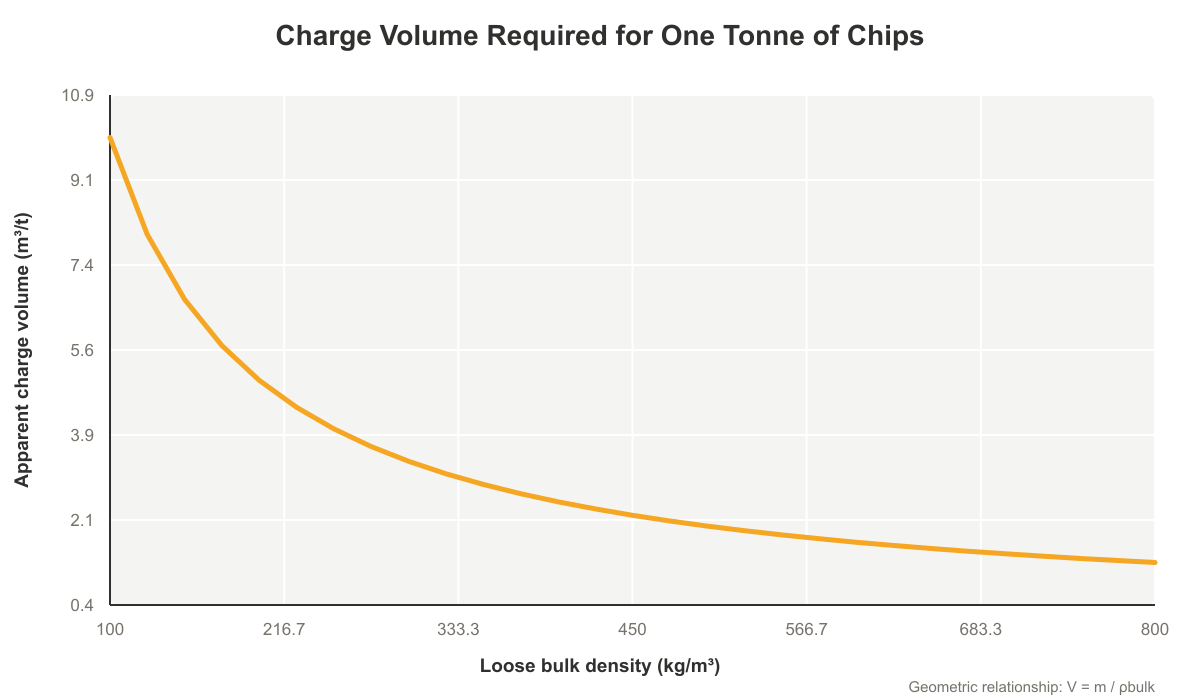
Figure: Shows the apparent volume required to contain one tonne of loose material.
A Correct Metal Mass Balance
Wet-feed yield and contained-metal recovery are different:
Reporting only wet-feed yield can penalize a process for water or oil that was never metal. Reporting only contained-metal recovery can hide feed-preparation costs. Both are useful when their denominators are explicit.
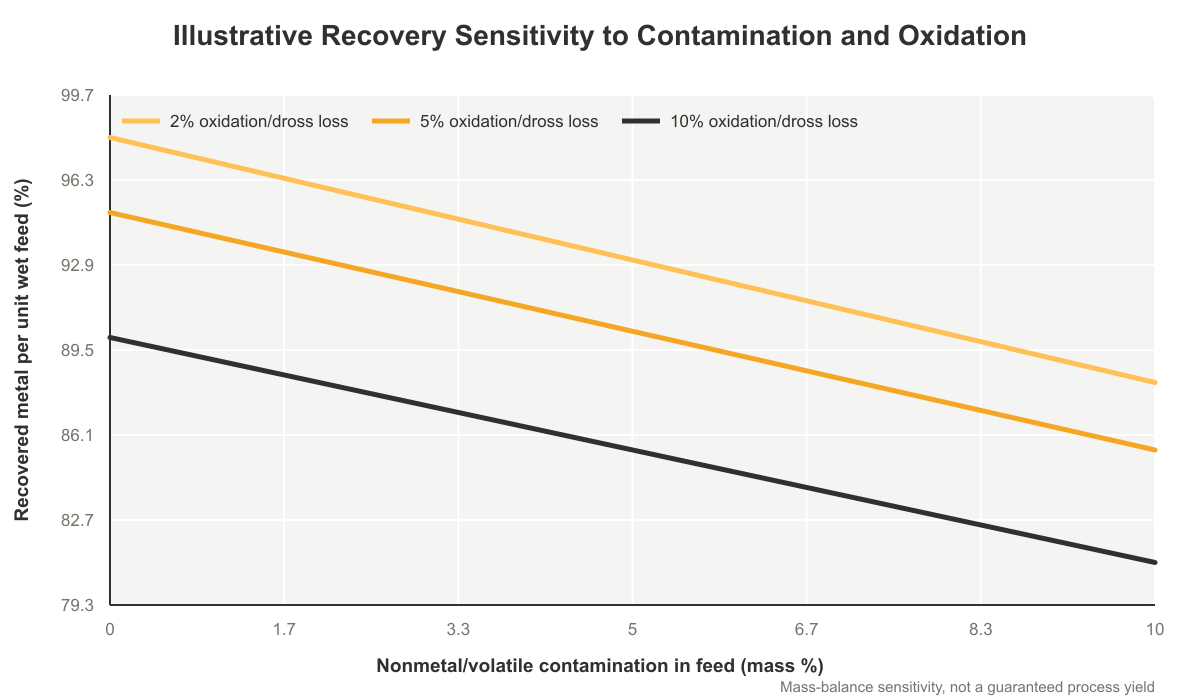
Figure: Illustrative mass-balance scenarios, not a guaranteed yield curve.
Worked Recovery Example
Consider 1,000 kg of wet feed containing 4% water, 3% oil/other nonmetal and 93% aluminum. The contained metal is 930 kg. If oxidation, dross and handling losses consume 6% of contained metal, recovered metal is:
Balance closure should include collected oil/water, filters, dust, dross, heel change, spills, sampling and scale uncertainty.
From Model to Plant Data
A scientifically useful chip-recovery study samples particle-size distribution, thickness or morphology, bulk density, moisture, oil/volatile content, metal chemistry, oxide/dross, feed mass, recovered mass and residual inventory. Samples must represent time-varying machining streams.
Uncertainty should accompany recovery. If recovered and contained-metal masses are independently measured, the approximate relative uncertainty is:
Plant trials should use repeated batches and confidence intervals rather than a single favorable run.
Reproducible Numerical Data
| Wet-feed component | Illustrative mass | Disposition |
|---|---|---|
| Contained aluminum | 930 kg | 94% recovered in worked example |
| Water | 40 kg | Removed before melting; ideal water duty ≈28.6 kWh |
| Oil/other nonmetal | 30 kg | Requires characterization and controlled removal |
| Recovered metal | 874.2 kg | 87.42% of wet feed; 94.0% of contained metal |
| Metal loss | 55.8 kg | Illustrative oxide/dross/handling term |
The plotted datasets are deterministic outputs from the equations and assumptions stated in this article. Values can be recalculated in a spreadsheet or engineering program using consistent units.
Assumptions, Limitations and What the Model Does Not Predict
- Chip geometry is simplified and does not predict oxide kinetics.
- Drying energy uses atmospheric water properties and excludes dryer inefficiency.
- Oxidation/dross loss is a scenario input, not a universal constant.
- Bulk density varies with morphology, vibration and measurement method.
- Moisture, oil and metal-content sampling error can dominate the recovery result.
Related Dynamo Engineering Resources
Chip, Swarf & Turnings Recovery
Plan the full preparation, drying, melting and recovery pathway.
Chip Processing Machines
Review washing and drying equipment for prepared machining residues.
Metal Recycling Applications
Connect feed characterization to recycling-furnace and output planning.
Frequently Asked Questions
Why do thin aluminum chips oxidize more readily?
Their high surface-to-volume ratio exposes more surface per unit metal volume. Geometry is one factor; time, temperature, atmosphere and contamination also matter.
How should chip recovery be reported?
Report both recovered metal divided by wet feed and recovered metal divided by contained metal, with clearly defined boundaries.
What is the theoretical energy to remove water?
It is the sensible heat to raise water to its boiling point plus latent heat of vaporization. Actual dryer use is higher.
Does higher bulk density guarantee higher recovery?
No. It can improve handling and reduce charge volume, but chemistry, moisture, contamination, oxide and furnace practice remain important.
Can this model establish safe charging conditions?
No. It is not a safety procedure. Equipment design, material verification and qualified site requirements govern charging.
Discuss an Aluminum Chip Recovery System
Send Dynamo your metal, feed form, production rate, temperature window, utilities, operating schedule, controls and project objectives. Engineering review must use project-specific data rather than the illustrative values in this article.
For product selection, the GM-M dedicated aluminum chip remelting furnace is the chip-focused option to review. When properly prepared chips accompany compatible clean production returns, compare the GM-G combined chip and scrap melting furnace. Neither selection makes wet feed acceptable or establishes a particular circulation mechanism.
References and Further Reading
- The Aluminum Association, Recycling
- Trunov et al., Oxidation and Melting of Aluminum Nanopowders (surface-area/oxide science; not a direct industrial-chip yield model)
- Dynamo chip, swarf and turnings recovery applications