Direct answer: a holding furnace is a dynamic thermal buffer. Bath temperature changes when heater input, enclosure losses, metal withdrawal and incoming refill enthalpy do not balance. Average capacity alone cannot predict stability; refill size, refill interval, incoming temperature, bath mass, available recovery power and control response determine the transient temperature seen by the casting process.
Model disclosure All calculations and graphs are reproducible illustrations based on the assumptions shown. They are not test data, performance guarantees, code-compliance calculations or substitutes for project-specific thermal, metallurgical, combustion, structural, electrical or safety engineering.
Nomenclature and Units
Symbol
Meaning
Unit
M
Molten bath mass
kg
cₚ
Liquid-metal specific heat
kJ/(kg·K)
T; T∞; T_in
Bath, ambient and refill temperatures
°C or K
Q̇_h
Net heater input to bath/control volume
kW
UA
Overall heat-loss coefficient × area
kW/K
ṁ_in; ṁ_out
Incoming and outgoing metal flow
kg/s
M_buffer
Required usable buffer mass
kg
t_replenishment
Time until replacement metal is available
h
A Lumped Bath Energy Balance
M cp dT/dt = Q̇h − UA(T−T∞) + ṁincpTin − ṁoutcpT
Well-mixed control-volume model; reference enthalpy must be consistent.
This ordinary differential equation represents storage, heater input, enclosure loss and metal-flow enthalpy. A more rigorous model may add separate metal, refractory and shell nodes; radiative openings; nonlinear burner or element behavior; stratification; heel geometry; and controller dynamics.
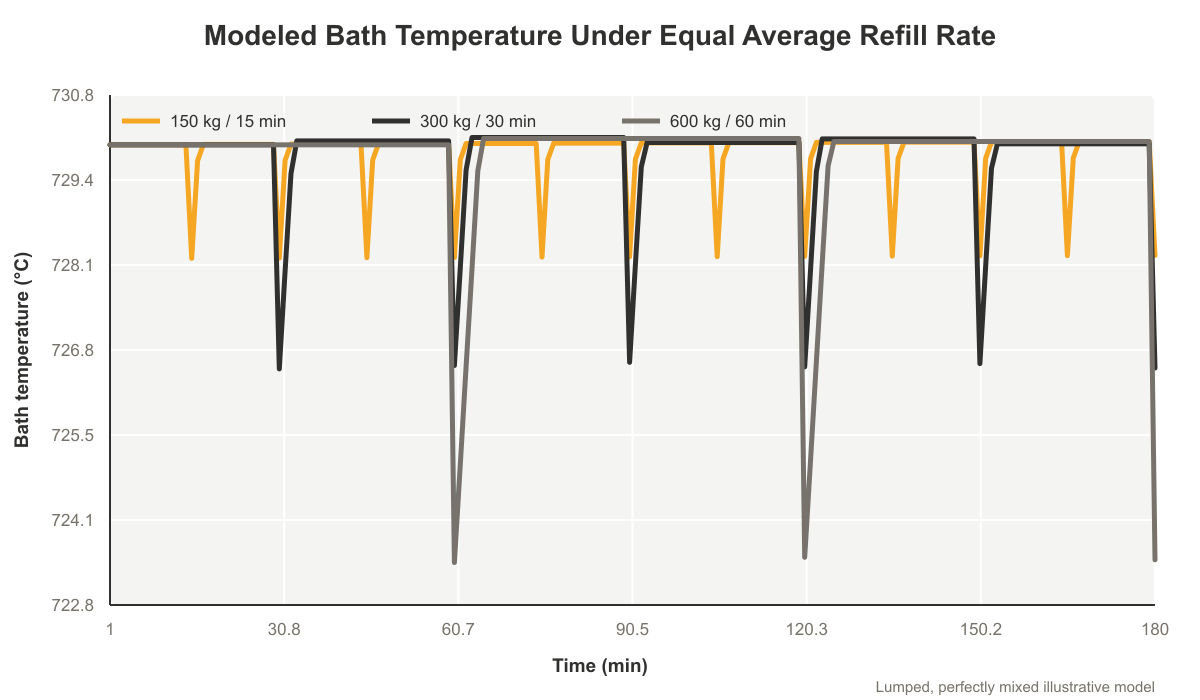
Figure: Equal average refill rate arranged as three different batch schedules.
Instantaneous Refill Mixing
Tmix = (MbTb + mrTr)/(Mb+mr)
Equal heat capacity assumed for the existing bath and refill.
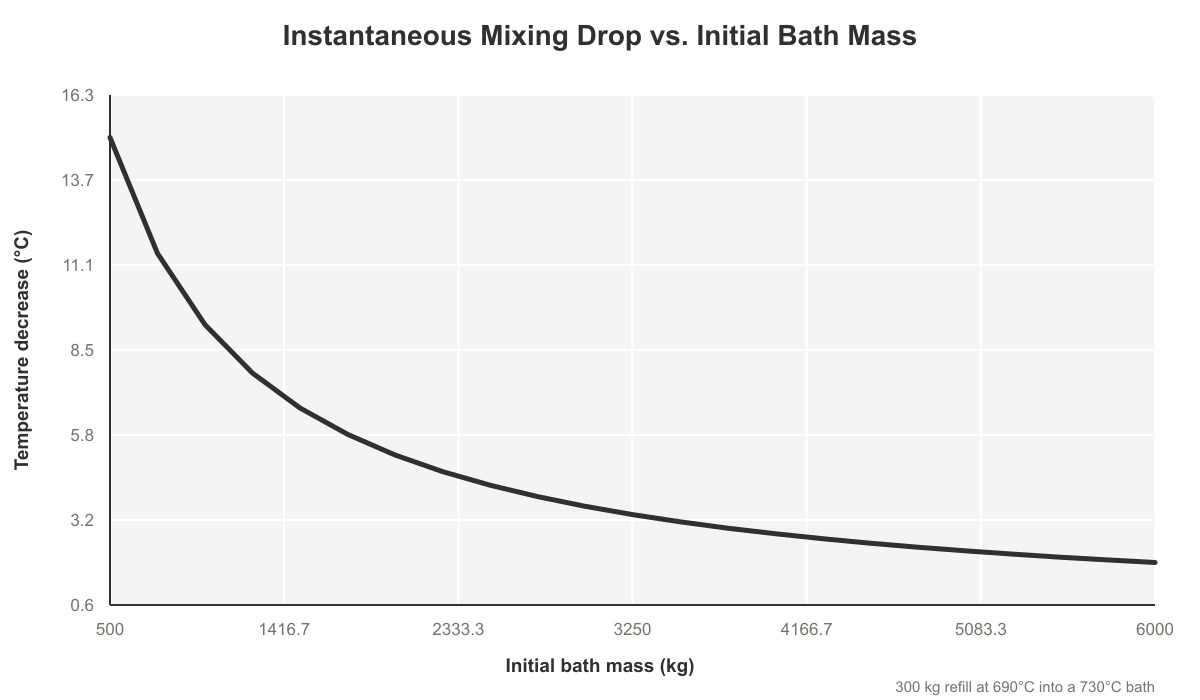
A 300 kg refill at 690°C mixed ideally with a 3,000 kg bath at 730°C produces T_mix ≈ 726.4°C—an immediate 3.6°C disturbance before recovery. The same average hourly metal demand can produce very different temperature excursions when delivered as small frequent refills or large infrequent batches.
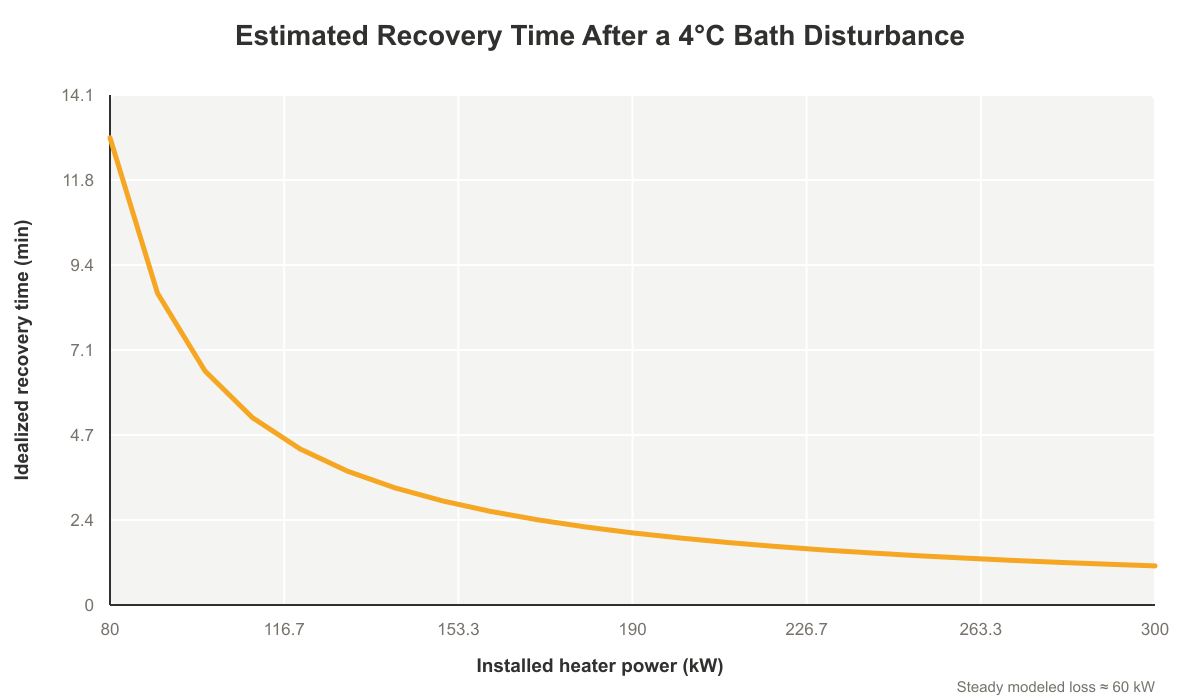
Figure: Shows sensitivity as net power approaches steady modeled heat loss.
Recovery Power and Time
Qrecovery = (Mb+mr)cp(Tset−Tmix)
Energy required to restore the mixed bath, excluding simultaneous losses.
trecovery ≈ Qrecovery/(Q̇available−Q̇loss)
Valid only when available net power remains positive.
Installed power is not equal to net bath power. Cycling, burner turndown, element limits, refractory storage, exhaust, lid position and control deadband change actual recovery. Close to the steady heat-loss requirement, predicted recovery time grows sharply.
Figure: Larger initial bath mass reduces the ideal instantaneous mixing drop.
Bath Mass as a Thermal Buffer
A larger bath reduces the fractional disturbance produced by a given refill, but it also increases molten inventory, residence time, stored energy and exposure to holding losses. Thermal stability is therefore a constrained optimization—not simply “more capacity is better.”
ΔTmix = Tb − Tmix
Use the mixing equation to quantify the initial disturbance.
Usable capacity must respect minimum heel, freeboard, level-control range, access, skimming and alloy-management limits.
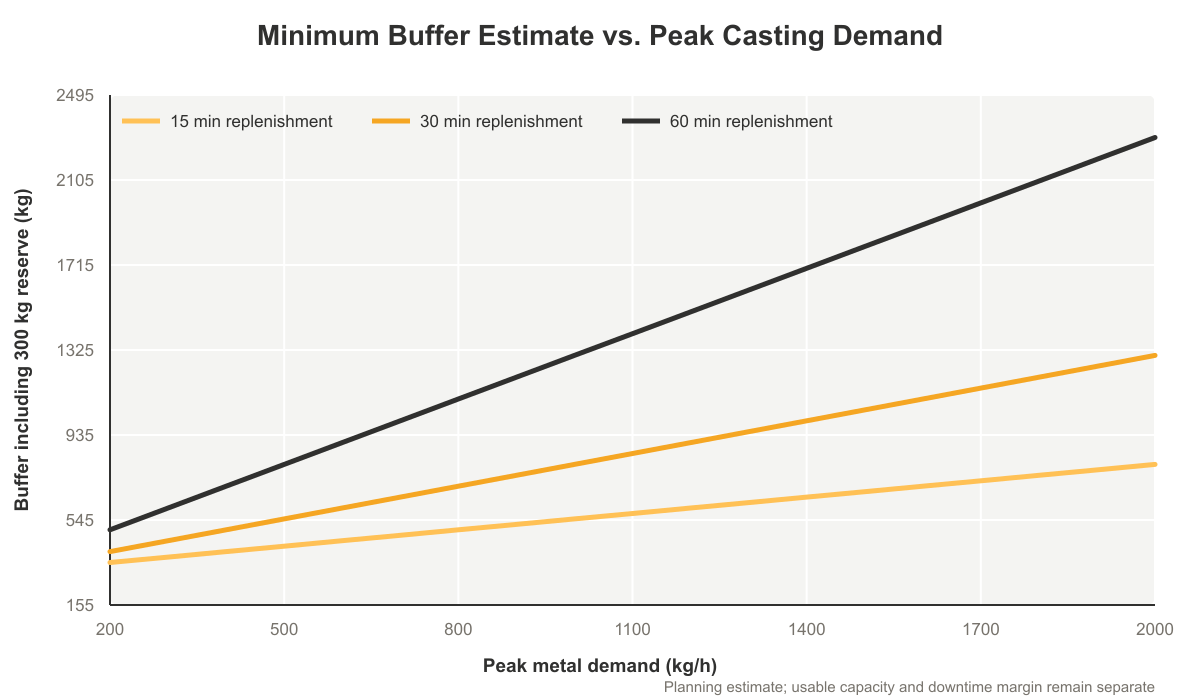
Figure: Planning estimate for different replenishment times with a fixed reserve.
Buffer Sizing for Casting Demand
Mbuffer ≥ ṁpeak treplenishment + Mreserve
A planning lower bound, not the total vessel capacity.
The model must use peak—not average—casting demand and include credible delivery interruption, refill temperature, recovery, usable bath range and production restart. A reserve should be justified by operational risk rather than chosen as an arbitrary percentage.
To turn the buffer estimate into an equipment specification, compare Dynamo’s electric aluminum holding furnaces, including EH-A Series, EH-B Series and EH-C Series. Review usable bath inventory, refill temperature, net recovery power and metal draw rate together. The equations and graphs here are illustrative planning calculations, not rated performance data for any of these products; the heater arrangement and recovery capability must be confirmed for the selected configuration.
Control-System Interpretation
Temperature control acts on a process with delay, thermal storage, actuator limits and discrete disturbances. An overly narrow deadband can cause unnecessary cycling; an overly broad band can expose production to unacceptable variation. Feedforward from refill events, level or metal-flow signals can improve response when engineered and validated properly.
A model should be calibrated against timestamped bath temperature, heater output, metal level or mass, refill events, lid state and casting demand. Residual analysis can reveal missing physics such as stratification, thermocouple lag or changing heat loss.
Reproducible Numerical Data
Model input
Illustrative value
Why it matters
Initial bath
3,000 kg at 730°C
Thermal storage
Refill
300 kg at 690°C
Discrete enthalpy disturbance
Liquid cₚ
1.18 kJ/(kg·K)
Converts energy to temperature change
UA
0.085 kW/K
Illustrative enclosure loss
Heater power
150 kW
Maximum modeled recovery input
Ambient
25°C
Heat-loss reference
The plotted datasets are deterministic outputs from the equations and assumptions stated in this article. Values can be recalculated in a spreadsheet or engineering program using consistent units.
Assumptions, Limitations and What the Model Does Not Predict
The bath is assumed perfectly mixed with one uniform temperature.
Refractory, shell and sensor dynamics are not modeled as separate states.
Metal withdrawal and refill timing are idealized.
UA and net heater power must be identified from plant or design data.
Alloy chemistry, oxidation, sludge and melt-quality effects require separate analysis.
Related Dynamo Engineering Resources
Molten Metal Holding Applications
Plan holding capacity, refill rhythm, residence time and metal transfer.
Incoming metal normally has lower specific enthalpy than the bath. Mixing redistributes energy and reduces the mean temperature before the heater restores it.
The net power must exceed steady losses and provide the desired recovery within the allowed time. Project-specific losses and control limits are required.
No. It is a planning model. Controller tuning requires validated plant dynamics, instrumentation and qualified controls engineering.
Discuss a Holding Furnace and Casting-Cell Model
Send Dynamo your metal, feed form, production rate, temperature window, utilities, operating schedule, controls and project objectives. Engineering review must use project-specific data rather than the illustrative values in this article.