

Blog
Energy and Exergy Analysis of Aluminum Melting Furnaces: Equations, Heat Losses and Specific Energy Consumption

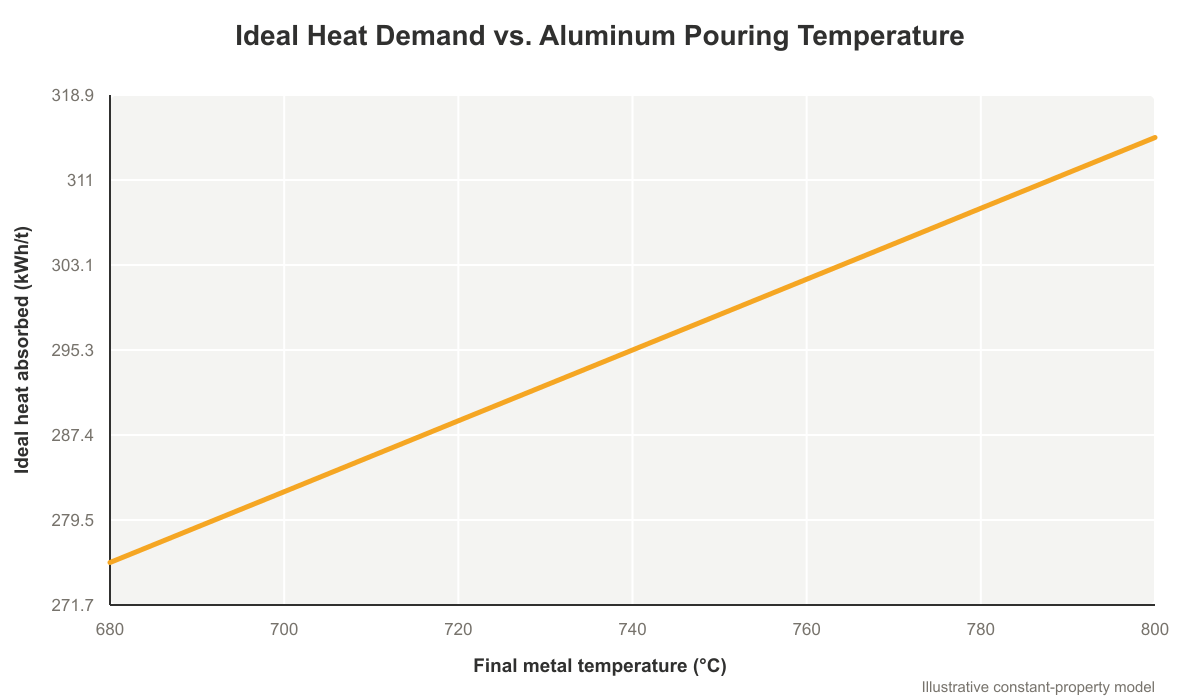
Direct answer: the minimum heat required to melt one tonne of aluminum is the sum of solid sensible heating, latent heat of fusion and liquid superheat. Real furnace input is higher because exhaust, walls, openings, holding, incomplete combustion, auxiliaries and operating practices consume energy without increasing the useful enthalpy of the delivered metal.
Energy efficiency measures how much supplied energy becomes useful metal heat. Exergy analysis asks the stricter question: how much of the supplied ability to perform useful work survives after irreversibility, mixing and heat transfer across finite temperature differences.
All calculations and graphs are reproducible illustrations based on the assumptions shown. They are not test data, performance guarantees, code-compliance calculations or substitutes for project-specific thermal, metallurgical, combustion, structural, electrical or safety engineering.
Nomenclature and Units
| Symbol | Meaning | Unit |
|---|---|---|
| m | Metal mass | kg |
| cₚ,s; cₚ,l | Mean solid and liquid specific heat | kJ/(kg·K) |
| T₀; Tₘ; Tₚ | Initial, melting and pouring temperature | °C or K |
| L_f | Latent heat of fusion | kJ/kg |
| E_input | Fuel or electrical energy supplied | kWh |
| SEC | Specific energy consumption | kWh/t |
| η_th | Net thermal efficiency | dimensionless or % |
| B | Exergy | kJ or kWh |
| T_ref | Environmental reference temperature | K |
First-Law Heat Balance
The useful heat absorbed by a metal charge can be approximated with three terms:
The complete furnace balance is:
A control-volume boundary must be stated. Fuel energy may use lower or higher heating value; electric input may be metered at the furnace or upstream of transformers and auxiliaries. Changing the boundary changes the reported efficiency.
Figure: Constant-property estimate showing how liquid superheat raises useful heat demand.
Specific Energy Consumption and Thermal Efficiency
SEC is practical for benchmarking, but it combines design, schedule and operating effects. A furnace with strong instantaneous combustion efficiency can still have poor shift SEC when it spends long periods holding a small bath, idling hot or reheating after production interruptions.
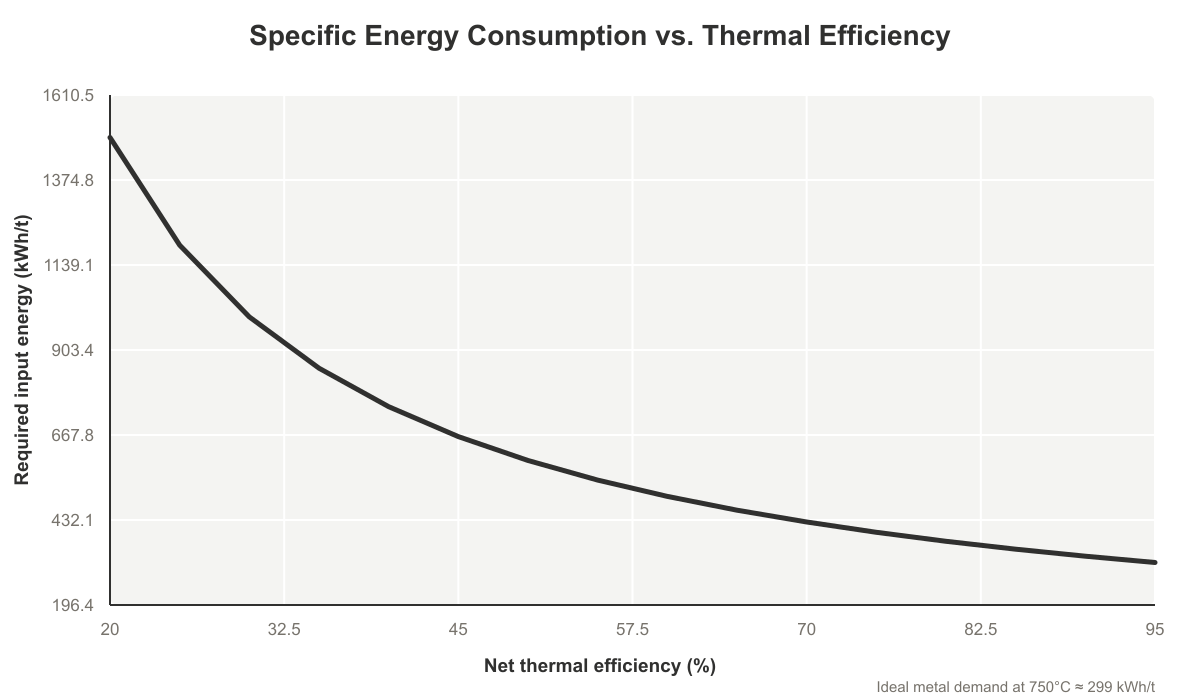
Figure: Input energy increases nonlinearly as net thermal efficiency falls.
Worked Example: One Tonne of Aluminum
Assume 1,000 kg enters at 25°C, melts at 660°C and is delivered at 750°C. Use mean cₚ,s = 0.90 kJ/(kg·K), L_f = 397 kJ/kg and cₚ,l = 1.18 kJ/(kg·K).
If the measured input is 1,050 kWh/t, the implied net thermal efficiency under this boundary is about 28.4%. Before comparing that value with another furnace, normalize metal temperature, alloy, heel, charge form, production utilization and metering boundary.
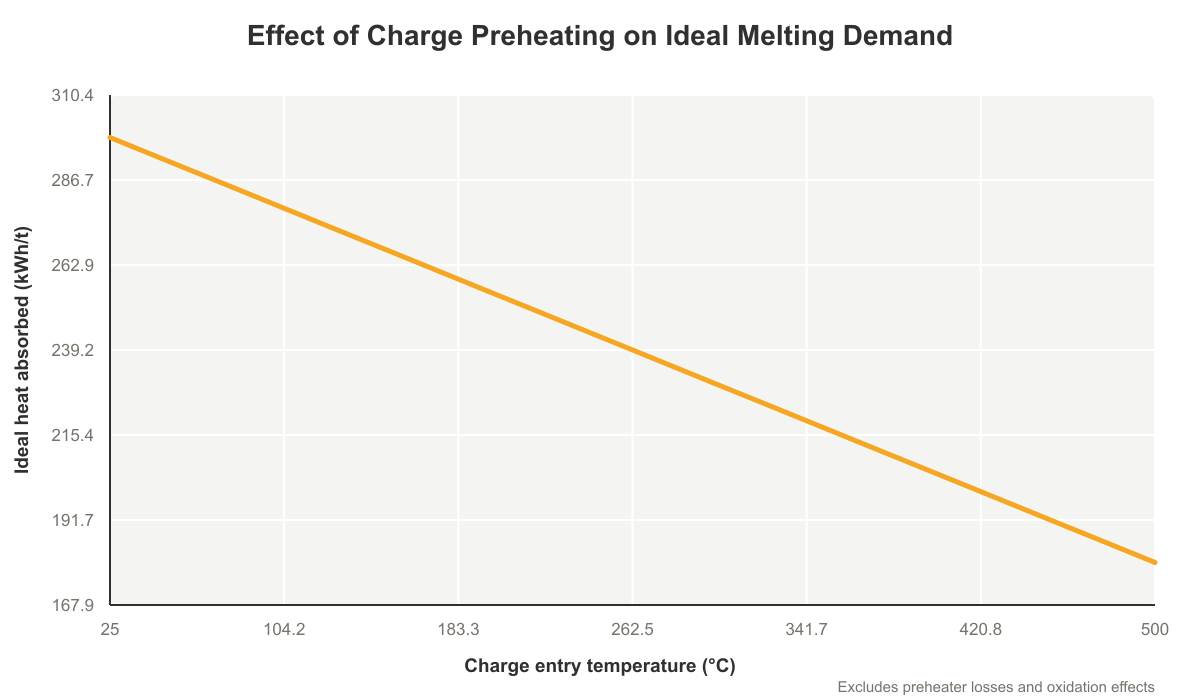
Figure: Ideal sensible-heat reduction from warmer charge entry.
Why Exergy Adds Information
One kilowatt-hour of electricity is essentially one kilowatt-hour of work potential. Heat supplied near ambient temperature has less work potential than heat at combustion temperature. Exergy destruction identifies irreversibility that an energy balance alone cannot reveal.
Large combustion temperature differences, hot exhaust, uncontrolled air infiltration, mixing and heat leakage can destroy exergy even though total energy is conserved. Exergy analysis is especially useful when comparing heat-recovery opportunities or investigating why reducing one loss changes the optimum elsewhere.
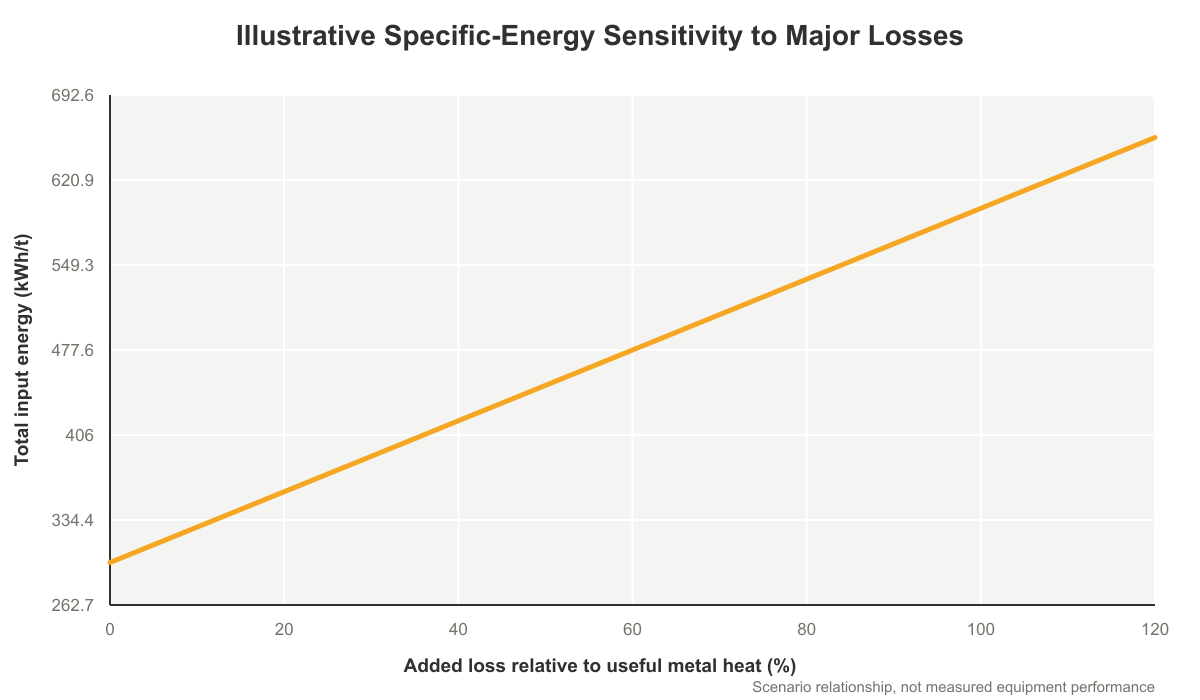
Figure: Illustrative relationship between useful metal heat and additional losses.
Charge Preheating and Heat Recovery
Preheating reduces the sensible heat that must be supplied inside the melting chamber. The ideal avoided metal-heating duty is:
Heat recovery must respect contamination, moisture, organic coatings, fume management, charge geometry, residence time and safe handling. A thermodynamic saving does not automatically prove that a preheater arrangement is safe or economically justified.
Measurement and Uncertainty
A useful furnace study records fuel volume and composition or electric kWh, charged and tapped weights, metal temperatures, operating time, downtime, exhaust oxygen and temperature, pressure, door or lid events, heel, dross, ambient conditions and auxiliary loads.
Uncertainty should be propagated rather than hidden. If energy and mass each have uncertainty, a first-order relative SEC uncertainty can be approximated by:
Plant comparisons should use confidence intervals and enough operating cycles to represent normal variability.
Reproducible Numerical Data
| Scenario | Calculated result | Interpretation |
|---|---|---|
| Ideal useful heat, 25→750°C | 298.5 kWh/t | Metal enthalpy only |
| 35% net efficiency | ≈853 kWh/t input | Illustrative operating boundary |
| 50% net efficiency | ≈597 kWh/t input | Same metal duty, lower losses |
| Charge preheated to 300°C | ≈230 kWh/t useful heat | Ideal furnace-chamber demand before preheater losses |
The plotted datasets are deterministic outputs from the equations and assumptions stated in this article. Values can be recalculated in a spreadsheet or engineering program using consistent units.
Assumptions, Limitations and What the Model Does Not Predict
- Mean properties do not capture alloy-specific temperature dependence.
- Oxidation, dross, fluxes and dissolved-gas effects are not predicted.
- Combustion calculations require measured fuel composition, excess air and exhaust data.
- Exergy results depend on the reference environment and stated system boundary.
- Charts must not be treated as Dynamo model performance curves.
Related Dynamo Engineering Resources
Industrial Metal Melting Applications
Connect heat demand to alloy, charge form, production rate and furnace configuration.
Gas vs Electric Melting Furnaces
Compare utility, control, emissions, maintenance and operating factors.
Energy Use in Aluminum Melting
Review how charge preparation and furnace style influence practical energy use.
Frequently Asked Questions
What is the theoretical energy required to melt aluminum?
It depends on starting and final temperatures and the thermophysical properties used. In the worked constant-property example, heating one tonne from 25°C to 750°C requires about 298.5 kWh of useful metal heat.
Why is actual furnace energy higher?
Exhaust, walls, openings, holding, auxiliaries, combustion and operating losses require additional input.
Is thermal efficiency the same as combustion efficiency?
No. Combustion efficiency concerns fuel conversion and exhaust losses; net thermal efficiency here compares useful metal heat with total supplied energy.
What does exergy analysis add?
It quantifies the degradation of energy quality and the destruction of work potential caused by irreversibility.
Can these graphs predict a Dynamo furnace guarantee?
No. They are transparent illustrative calculations, not measured or guaranteed equipment performance.
Discuss an Aluminum Melting Energy Study
Send Dynamo your metal, feed form, production rate, temperature window, utilities, operating schedule, controls and project objectives. Engineering review must use project-specific data rather than the illustrative values in this article.