Blog
Mission Accomplished: Two Dry-Hearth Aluminum Gas Melting Furnaces Shipped & Commissioned
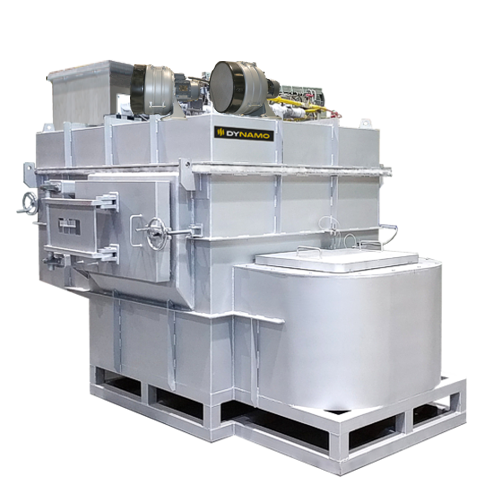
When the GM‑D‑4400 completed its final round of testing and pre‑commissioning at our facility, the furnace had already proven itself under simulated production conditions. It had passed mechanical inspections, electrical validation, automation logic checks, and a full thermal performance test. But the true measure of a Dynamo furnace begins when it arrives at the customer’s foundry — when it transitions from a factory‑tested system to a fully integrated part of a live production environment.
Phase 3 is where engineering meets reality. It’s where our team works side‑by‑side with the customer to install, commission, and optimize the furnace for their specific workflow. And it’s where operators, maintenance staff, and supervisors gain the confidence to run the system safely, efficiently, and consistently.
This phase is the culmination of months of collaboration, planning, and precision. It’s also the moment when the customer begins to see the full value of their investment — not just in the equipment itself, but in the partnership behind it.
👉 Review the journey of these 2 Dry-Hearth Furnaces in design & assembly (stage 1) and finalizing & pre-commissioning here:
Loading and Shipment
Once the GM‑D‑4400 passed its final inspections, our logistics team coordinated the shipment with the same precision that defined every earlier stage of the project. The furnace was carefully secured onto a reinforced flatbed trailer using certified tie‑down points designed into the frame during engineering. Protective coverings were added to safeguard the refractory, burner assemblies, and control components during transit. Working closely with the customer’s receiving team, we scheduled the delivery window to align with rigging availability and plant access requirements. When the truck arrived on site, the loading and unloading process was executed smoothly — guided by Dynamo technicians who ensured the furnace was lifted, positioned, and staged exactly according to the installation plan. This attention to detail during shipment and loading ensures the equipment arrives in perfect condition and ready for immediate installation.
Arrival and Site Preparation — Setting the Stage for a Smooth Installation
Before the furnace ever left our facility, our logistics team coordinated closely with the customer to ensure the site was fully prepared. This included verifying:
Foundation readiness: concrete pad dimensions, load‑bearing capacity, and anchor locations.
Gas and air supply routing: ensuring proper line sizing and isolation valves.
Electrical service availability: confirming panel capacity, breaker sizing, and conduit paths.
Material flow layout: positioning the furnace to support efficient charging, melting, and casting.
Safety clearances: maintaining adequate space for maintenance access and emergency egress.
These pre‑installation checks ensure that when the furnace arrives, installation proceeds without delays or unexpected modifications.
When the GM‑D‑4400 reached the customer’s facility in Arkansas, the site was ready. The receiving team had cleared the staging area, rigging equipment was in place, and utilities were pre‑positioned. This level of preparation is a testament to the customer’s professionalism — and to the detailed planning completed during Phase 1.
Rigging and Positioning
Installing a furnace of this size requires careful coordination. The GM‑D‑4400 is a heavy, high‑temperature industrial system, and positioning it correctly is essential for long‑term performance.
Our field technicians worked with the customer’s rigging crew to:
Lift and position the furnace using certified lifting points.
Align the furnace with the foundation anchors to ensure structural stability.
Verify hearth and bath orientation relative to the charging and casting workflow.
Confirm burner access and maintenance clearances.
These rigging procedures are executed with millimeter‑level precision. Even small deviations can affect burner alignment, airflow, or refractory performance — which is why Dynamo technicians oversee every step.
Once the furnace was secured to the foundation, the installation moved into the next stage: utility connections.
Utility Integration: Connecting the Furnace to the Foundry
A melting furnace is only as reliable as the utilities that support it. During this stage, our technicians worked with the customer’s maintenance team to connect:
Natural gas supply lines with proper regulators and shutoff valves.
Combustion air lines routed to the VFD‑controlled blowers.
Electrical power feeds to the PLC cabinet, blowers, actuators, and safety circuits.
Thermocouple and sensor wiring to ensure accurate temperature feedback.
Exhaust and ventilation systems to maintain safe operating conditions.
Each connection underwent a detailed verification process, including:
Leak testing for gas lines.
Continuity and polarity checks for electrical circuits.
Airflow calibration for combustion systems.
Grounding and bonding verification for operator safety.
These utility integration steps ensure the furnace operates safely and efficiently from the moment it is powered on.
Commissioning: Bringing the Furnace Online
Commissioning is where the furnace transitions from a static installation to a fully operational melting system. This stage is performed by Dynamo’s field service engineers, who follow a structured commissioning protocol designed to validate every aspect of the furnace’s performance.
1. Cold Commissioning
Cold commissioning involves powering the furnace without firing the burners. During this stage, our team verified:
PLC startup sequences
HMI navigation and operator screens
Door actuators and limit switches
Blower rotation and VFD response
Safety interlock behavior
These cold‑start checks ensure that all mechanical and electrical systems respond correctly before heat is introduced.
2. Burner Ignition and Flame Tuning
Once cold commissioning was complete, the burners were ignited for the first time on site. Our combustion specialists:
Adjusted air‑fuel ratios for stable ignition.
Tuned flame profiles to match the hearth geometry.
Verified flame safety systems and automatic shutdown sequences.
Monitored combustion efficiency to minimize fuel consumption.
These combustion tuning steps ensure the furnace operates with maximum thermal efficiency and minimal emissions.
3. Thermal Ramp‑Up
The furnace was gradually brought up to operating temperature to allow the refractory to expand evenly. During this stage, our team monitored:
Temperature gradients across the hearth and holding bath.
Refractory expansion behavior to ensure structural integrity.
Burner modulation under varying load conditions.
PLC temperature control stability.
These thermal ramp‑up procedures protect the refractory and ensure long‑term durability.
4. First Melt and Production Simulation
With the furnace at temperature, the customer loaded their first batch of aluminum scrap. Our technicians observed:
Dry‑hearth melting behavior
Metal flow into the holding chamber
Temperature recovery after charging
Operator workflow through the HMI
This first‑melt validation confirmed that the furnace performed exactly as expected under real production conditions.
Operator Training
A furnace is only as effective as the people who operate it. That’s why Dynamo provides comprehensive on‑site training covering every aspect of operation, safety, and maintenance.
Training Modules Delivered On Site
System overview: architecture, components, and process flow.
HMI navigation: melt cycles, temperature control, alarms, and data trends.
Charging and melting procedures: best practices for scrap loading and alloy handling.
Safety protocols: emergency stops, interlocks, and safe operating zones.
Routine maintenance: burner cleaning, refractory inspection, and sensor checks.
Troubleshooting fundamentals: interpreting alarms and responding to common scenarios.
By the end of training, operators were confident, maintenance staff were prepared, and supervisors understood how to monitor performance and optimize melt cycles.
Performance Optimization: Fine‑Tuning for Maximum Efficiency
After the furnace completed its first production cycles, our team worked with the customer to optimize:
Melt cycle timing
Charging intervals
Temperature setpoints
VFD blower curves
Burner modulation thresholds
These optimization adjustments ensure the furnace delivers maximum throughput with minimum energy consumption.
Within the first week of operation, the customer reported:
Faster melt times
Lower gas usage
Improved metal cleanliness
Reduced operator workload
This is the moment when the value of a Dynamo furnace becomes unmistakable.
Final Handover
Once commissioning, training, and optimization were complete, the project moved into final handover. This included:
Documentation package: schematics, manuals, maintenance schedules, and PLC backups.
Performance report: melt rates, energy usage, and thermal stability data.
Spare parts recommendations for long‑term reliability.
Warranty activation and service contact information.
With the GM‑D‑4400 fully operational, the customer’s foundry gained a powerful new asset — a furnace engineered for aerospace‑grade aluminum, optimized for efficiency, and supported by a team committed to long‑term success.
Let Us Make Your Next Furnace
For virtually every production scenario, we have a dedicated type of high capacity furnace. Be it a crucible furnace or a large tower melting furnace - we have a solution for you.
To experience a smooth journey from filling the information request form to having your order delivered at your factory, visit our products page.

For More Information About This Furnace
For More Information About Other Furnaces