

Blog
Ingot vs. Sow Casting: Which Fits Your Foundry’s Production Goals?


Introduction
Every foundry faces the challenge of turning molten metal into high-quality, usable feedstock efficiently. But not all feedstock is created equal. Two of the most common casting forms—ingots and sows—offer distinct advantages and challenges, and choosing the right one can make or break your production efficiency, quality, and profitability.
Imagine a busy aluminum foundry: on one side, workers carefully manage standardized ingots, each batch ready to flow seamlessly into downstream processes. On the other hand, massive sows dominate the workspace, requiring heavy equipment, careful planning, and robust infrastructure to move, remelt, and process. Both approaches serve a purpose—but the right choice depends on your production goals, throughput requirements, alloy variety, and quality expectations.
This article dives deep into the technical, operational, and financial considerations of ingot versus sow casting, helping you align your casting strategy with your foundry’s real-world goals.
👉 And if you’re looking for a trusted partner to supply the right melting and holding equipment, Dynamo Furnaces has decades of experience designing furnaces.
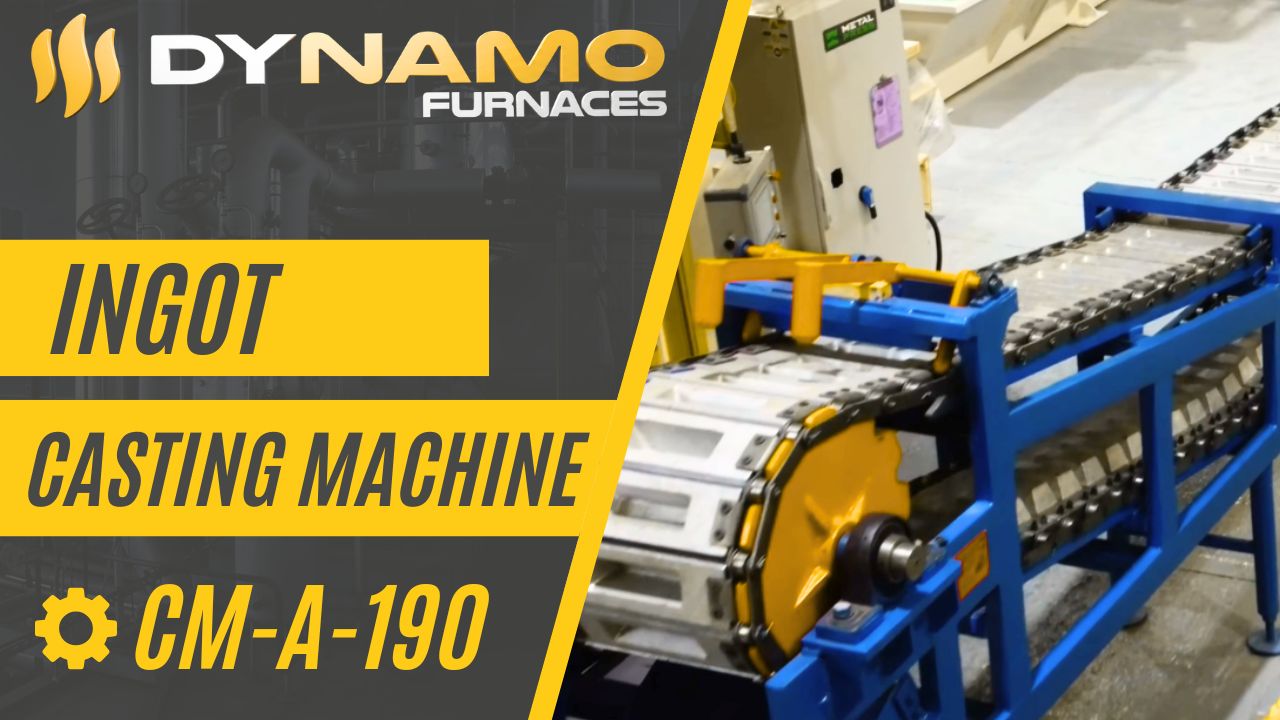
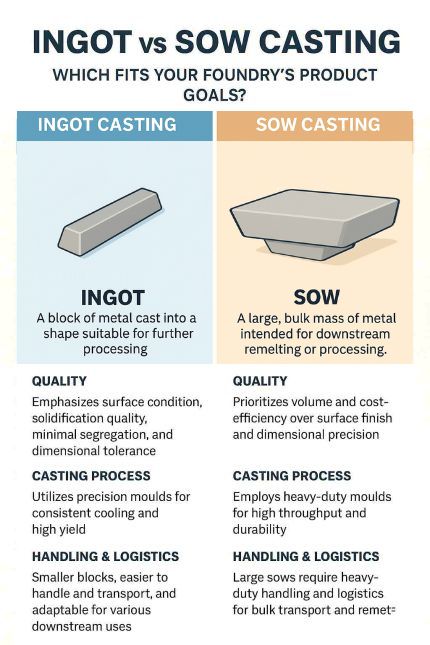
Ingot – A cast metal block (or other standard shape) intended for further processing (remelting, extrusion, forging, or as feedstock for downstream casting). In the aluminum foundry industry, ingots may be produced in a range of sizes: from small “foundry ingots” of tens of kilograms up to larger “T‑ingots” of several hundred kilograms or more.
Sow (casting) – A large, often bulky mass of molten metal cast into a form that will be broken down or re‑melted further. Sows often handle very large blocks and are typically used in primary or secondary metal supply chains rather than as final feedstock for highly refined processes.
The distinction between ingot and sow casting matters because the casting size, handling, re‑melting, and downstream processing requirements differ significantly. This choice directly impacts furnace sizing, mold design, cooling strategy, logistics, yield, and quality metrics such as segregation, porosity, and surface finish. Choosing the right furnace supplier is critical, and Dynamo Furnaces has a proven track record of delivering high-efficiency systems tailored to your specific casting requirements.
Key Comparison: Ingot vs Sow
Feature | Ingot Casting | Sow Casting |
Typical size & weight | Smaller, standardized shapes for manageable handling, remelting, or direct use. | Much larger sizes, often bulk blocks, intended for breakdown or re‑melting. |
Handling & logistics | Easier to handle, transport, and store. Molds and equipment sized for moderate weight. | Requires heavier handling infrastructure, including cranes, trolleys, and conveyors. |
Downstream processing readiness | Often closer to final use; minimal additional processing. | Typically intermediate stock requiring additional breakdown or re‑melting. |
Melt & casting equipment implications | Moderate-size melts allow furnace flexibility and optimized pour control. | Large volume pours demand robust furnace capacity and careful cooling. |
Quality control / metallurgical aspects | Smaller size and controlled cooling result in better structural uniformity and minimal segregation. | Slower cooling in large sows increases risk of macro-segregation and thermal gradients. |
Yield, scrap, material loss | Smaller blocks often lead to lower material loss and efficient downstream usage. | Handling and breakdown of sows can lead to higher scrap and yield loss. |
Flexibility to production changes | Allows frequent alloy changeovers and smaller batch adjustments. | Less responsive due to heavy handling and large batch requirements. |
Ideal use-case | Best suited for foundries needing flexible feedstock, high-quality casting, and moderate production volumes. | Suitable for high-throughput operations focused on volume rather than frequent size or alloy changes. |
.
When Does Each Fit Your Foundry’s Production Goals?
For foundries requiring frequent alloy changes and flexible production schedules, ingot casting is typically the preferred choice. Smaller, standardized ingots are easier to handle, allow for better quality control, and minimize reprocessing. Foundries that need to produce feedstock suitable for die casting, investment casting, or extrusion benefit from the predictable and manageable characteristics of ingots.
Sow casting, on the other hand, is often the choice for high-volume, low-alloy-variation foundries. Large blocks reduce per-unit handling costs and allow for efficient mass feedstock production. Sows require heavy handling infrastructure, such as cranes and trolleys, and are better suited for operations where downstream remelting is already integrated. While sows may be less flexible, they are cost-effective for large-scale production runs.
👉 For foundries looking to procure furnaces for either ingot or sow operations, Dynamo Furnaces is a trusted partner, providing tailored solutions for your needs. You can contact our specialists or view all our products.
Casting Line Design Considerations
Furnace size vs cast weight: Large sows require melting furnaces capable of handling the full volume of molten metal plus pouring margin. Over-sized or partial fills reduce efficiency. Dynamo Furnaces offers electric and gas melting/holding furnaces suitable for a wide range of casting operations, including sand, high-pressure die, and investment casting. Ingot casting, with its moderate batch sizes, allows furnaces to be optimized for frequent fills and faster turnaround.
Pouring and cooling strategy: Large blocks present challenges with slower cooling and higher thermal gradients, which can increase defects. Ingot casting offers more manageable solidification distances, supporting finer grain structures and consistent quality. Advanced furnace control systems, such as those offered by Dynamo Furnaces, help optimize melt quality and pour timing for either approach.
Material quality and alloy management: When downstream processes demand high-purity metal with controlled trace elements, ingot casting is advantageous due to better control of melt and cast cycles. Sow casting is generally suitable for operations tolerant of some variation in feedstock quality, particularly when using scrap or secondary materials.
Handling infrastructure: Sows require robust handling systems, including robotized skimming, vacuum demolding, and automated stacking. Ingot casting benefits from standardized sizes that simplify material flow, storage, and transportation, requiring less heavy infrastructure.
Throughput scheduling and alloy changeover: Ingot casting allows more flexible batch scheduling, accommodating multiple alloys and rapid changeovers. Sow casting suits operations with large, stable batches and minimal changeovers.
Return on Investment (ROI) & cost per kg: Sows may lower per-kg handling costs but require significant infrastructure and may incur higher handling losses. Ingot casting, while potentially slightly higher per lbs or kg, can reduce scrap, improve yield, and offer flexibility that boosts overall ROI.
For related equipment-planning guidance, compare Dynamo’s die casting foundry melting and holding applications and ingot, sow, and deox casting applications.
👉 For foundries looking to procure furnaces for either ingot or sow operations, Dynamo Furnaces is a trusted partner, providing tailored solutions and technical expertise for both approaches.
Conclusion
Ultimately, choosing between ingot and sow casting isn’t just a technical decision—it’s a strategic one. If your operation demands flexibility, frequent alloy changes, and the highest quality feedstock, ingots provide predictable handling, precise control, and streamlined downstream integration. If your priority is high-volume production with stable alloys and cost-efficient mass handling, sows can deliver the throughput you need, provided your infrastructure is built to manage them.
At Dynamo Furnaces, we understand that every foundry is unique. Our melting and holding systems are designed to support both approaches, whether you need flexible, rapid-turnaround ingot casting or large-scale sow operations with robust handling capabilities. By carefully evaluating your production workflow, throughput, and quality requirements, you can make the casting choice that maximizes efficiency, yield, and ROI—turning molten metal into both performance and profit.
Let Us Help You Select Your Next Ingot Casting Machine
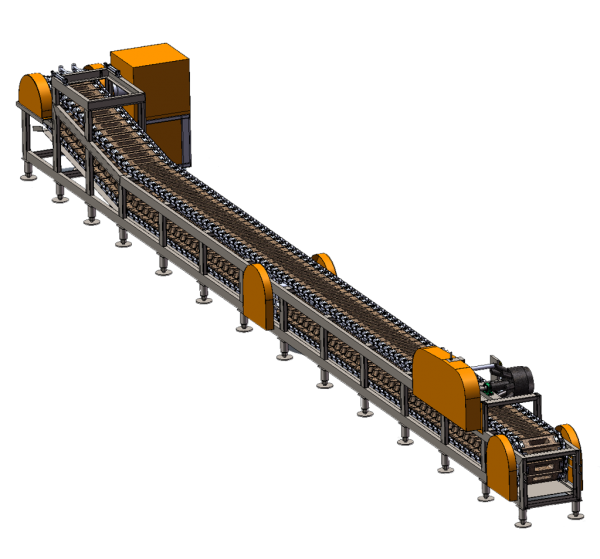
For virtually every production scenario, we have a dedicated type of product. Be it a crucible furnace or an ingot casting machine - we have a solution for you.
To experience a smooth journey from filling the information request form to having your order delivered at your factory, visit our products page.
For More Information About Ingot Casting Machine
For More Information About Other Furnaces