

Blog
Understanding Annealing: How Aluminum Heat Treatment Improves Strength, Ductility, and Formability


Introduction: Why Aluminum Annealing Is Essential in Modern Manufacturing
Aluminum is one of the most widely used metals in the world, valued for its light weight, corrosion resistance, and excellent formability. But aluminum does not leave the casting or rolling process in its final usable state. Internal stresses, work hardening, and microstructural inconsistencies can make the metal brittle or difficult to form. That’s where annealing comes in.
Annealing is a controlled heat‑treating process that softens aluminum, improves ductility, relieves internal stresses, and restores the metal’s ability to be shaped without cracking. Whether you’re producing sheet aluminum for automotive panels, extrusions for construction, or cast components for industrial machinery, annealing ensures the material performs reliably during forming, machining, and final assembly.
Although annealing is a heat‑treating process rather than a melting operation, aluminum foundries and processing facilities rely heavily on melting and holding furnaces to support upstream and downstream production. The quality of the molten aluminum used in casting directly affects the microstructure that later responds to annealing.
This guide explains how aluminum annealing works, why it matters, and how modern furnace systems support efficient, high‑quality heat treatment.
What Annealing Does to Aluminum
Annealing fundamentally changes the internal structure of aluminum. During rolling, forging, machining, or forming, aluminum becomes work‑hardened. Dislocations accumulate within the metal’s crystal lattice, making it stronger but less ductile. If the metal is bent or formed further, it may crack.
Annealing reverses this by heating the aluminum to a controlled temperature—typically between 300°C and 410°C (570°F to 770°F)—and holding it long enough for recovery and recrystallization to occur. During this process, the metal’s internal structure reorganizes, relieving stresses and restoring ductility.
The result is aluminum that is easier to form, bend, stamp, or machine. Annealing also improves dimensional stability and reduces the risk of cracking during fabrication.
The Three Stages of Aluminum Annealing
Although annealing is often described as a single process, it actually consists of three distinct metallurgical stages.
Recovery
During recovery, the aluminum is heated enough to allow dislocations to rearrange and reduce internal stresses. The metal becomes slightly softer and more ductile, but its grain structure remains largely unchanged.
Recrystallization
As the temperature increases, new strain‑free grains begin to form. These grains replace the deformed structure created during work hardening. Recrystallization dramatically increases ductility and reduces hardness.
Grain Growth
If the aluminum is held at high temperature for too long, the grains begin to grow larger. Excessive grain growth can reduce strength, so precise temperature control is essential.
Modern annealing furnaces must maintain stable temperatures to ensure consistent results. Upstream melting systems also play a role, as the initial grain structure formed during casting affects how the metal responds to annealing.
How Aluminum Is Prepared for Annealing
Before annealing, aluminum must be cast, rolled, or extruded into its working form. The quality of the molten aluminum used in these processes directly influences the success of annealing. Impurities, temperature fluctuations, and inconsistent melt quality can lead to defects that annealing cannot fully correct.
This is why aluminum foundries rely on high‑efficiency melting systems such as the Tilting Stack Melting Furnace or the Mini Stack Melting Furnace to produce clean, consistent molten aluminum.
Holding furnaces also play a critical role. Systems like the Gas Holding Furnace and the Electric Holding Furnace EH‑A maintain stable temperatures during casting operations, ensuring uniform microstructure before annealing.
Annealing Temperatures for Different Aluminum Alloys
Not all aluminum alloys anneal the same way. Pure aluminum requires lower temperatures, while alloys containing magnesium, silicon, or copper may require higher temperatures or longer soak times.
For example:
1xxx series aluminum anneals easily at lower temperatures.
3xxx and 5xxx series require moderate temperatures and careful control to avoid over‑softening.
6xxx series (aluminum‑magnesium‑silicon) respond well to annealing but must be handled carefully to preserve precipitation‑hardening potential.
2xxx and 7xxx series are typically not annealed in the same way due to their heat‑treatable nature.
Because annealing temperatures are relatively low compared to melting, energy efficiency is high. However, the initial casting and melting operations must be stable to ensure predictable annealing behavior.
How Furnace Design Influences Annealing Quality
Annealing requires precise temperature control and uniform heat distribution. Even small fluctuations can lead to uneven grain structure, inconsistent ductility, or partial recrystallization.
Batch furnaces are commonly used for sheet, plate, and formed aluminum components. Continuous furnaces are used in high‑volume operations such as coil annealing. Regardless of the furnace type, the quality of the aluminum entering the annealing process depends heavily on upstream melting and holding systems.
For example, facilities that melt aluminum scrap or chips often use systems such as the Aluminum Scrap Rotary Recycling Furnace or the Aluminum Chip Melting Furnace to reclaim material before casting and annealing.
These recycling furnaces ensure that reclaimed aluminum has consistent chemistry and low contamination levels, which improves annealing performance.
Applications of Annealed Aluminum
Annealed aluminum is used across nearly every industry. Automotive manufacturers rely on annealed sheet aluminum for body panels and structural components. Aerospace companies use annealed aluminum for forming complex shapes without cracking. Construction, HVAC, packaging, and consumer goods industries all depend on annealed aluminum for its formability and stability.
Foundries that produce cast aluminum components often anneal parts before machining to reduce tool wear and improve dimensional accuracy. Annealing also prepares aluminum for deep drawing, bending, stamping, and hydroforming.
Common Annealing Defects and How to Prevent Them
Defects such as uneven grain size, incomplete recrystallization, or excessive softening typically result from poor temperature control or inconsistent material quality. These issues often originate upstream during melting or casting.
Using high‑quality melting systems such as the Dry Hearth Melting Furnace or electric systems like the Square Crucible Melting Furnace helps ensure that the aluminum entering the annealing process has a uniform microstructure and predictable response to heat treatment.
Conclusion: Annealing Is the Key to High‑Performance Aluminum Products
Annealing is a critical step in aluminum manufacturing, restoring ductility, relieving internal stresses, and preparing the metal for forming and machining. Whether you produce sheet aluminum, cast components, extrusions, or recycled aluminum products, annealing ensures consistent performance and long‑term reliability.
Upstream melting and holding systems play a major role in the success of annealing. High‑efficiency furnaces such as the Tilting Stack Melting Furnace and the Electric Holding Furnace EH‑A help create the stable microstructure needed for predictable annealing results.
With the right combination of melting, holding, and heat‑treating equipment, manufacturers can produce aluminum products that meet the highest standards of strength, formability, and performance.
We Make Your Next Melting Furnace
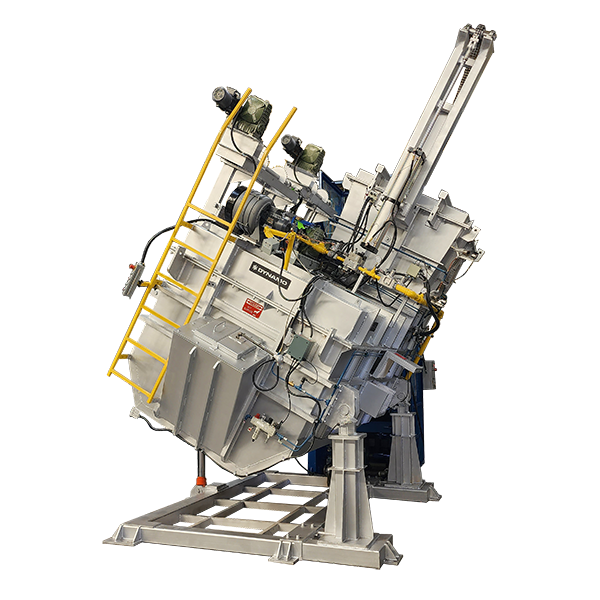
For every production scenario, we have a dedicated type of high-capacity furnace. Be it a crucible furnace or a large tower melting furnace. Dynamo Furnaces provides top foundry solutions across United States, Canada, Mexico, and South America.
To experience a smooth journey from filling the information request form to having your order delivered at your factory, visit our products page.
For related equipment-planning guidance, compare Dynamo’s industrial heat treatment furnace applications and aluminum melting and holding furnace applications.
For the complete aluminum treatment sequence, review Dynamo’s aluminum solution heat treatment, quenching and aging guide, including load uniformity, transfer time, quench control, distortion and final-property planning.