Blog
EM-B-3500 Electric Melting Furnace Commissioning & Shipment To Pennsylvania Heavy Equipment Manufacturer
Consultation & Furnace Selection
After weeks of engineering, fabrication, testing, and validation, the EM‑B‑3500 Electric Square Crucible Melting Furnace has reached its final chapter in our production facility. In Phase 1, we explored the design, fabrication, and assembly of this high‑capacity aluminum melting system. In Phase 2, we walked through the rigorous testing, inspection, and quality assurance steps that ensured the furnace met every performance and safety requirement.
👉 If you missed those earlier stages, you can revisit them here:
With the furnace now fully certified and prepared for transport, it’s time to follow its journey from our Cambridge manufacturing floor to the customer’s aluminum casting plant in Pennsylvania. This final phase covers shipment, arrival, installation, commissioning, operator training, and the first production run—the moment when engineering becomes real‑world performance.
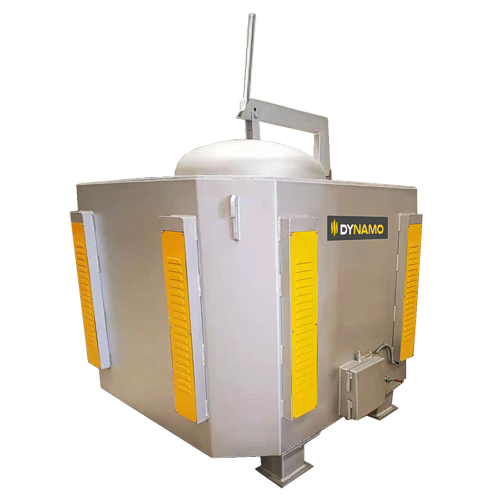
EM‑B‑3500 FurnaceEM‑B‑3500 Furnace
Before we dive into logistics and commissioning, it’s worth revisiting what makes the EM‑B‑3500 such a valuable asset for high‑volume aluminum casting operations.
The EM‑B‑3500 is part of Dynamo’s EM‑B Series: a family of electric square crucible melting furnaces designed for continuous melting and holding applications. Built with silicon carbide heating rods, a reinforced steel shell, and a high‑efficiency refractory system, the furnace delivers:
High melting rates suitable for automotive and heavy‑equipment casting
Energy‑efficient operation with minimal thermal loss
Precise temperature control through a PLC‑driven system
Easy maintenance access thanks to side‑removable heating rods
Long refractory life supported by multi‑layer insulation
For this project, the customer required a custom configuration that allowed all heating rods to be serviced from only two sides due to tight floor‑space constraints. Our engineering team integrated this requirement seamlessly into the design.
Now, with the furnace fully tested and approved, the next step is getting it safely to its new home.
👉 Our client contacted us through a request for information form. You can ask our specialists about the EM-B Series.
Preparing the Furnace for Shipment
Once the EM‑B‑3500 passed its Factory Acceptance Test, our logistics team began preparing it for transport. Shipping a 3,500‑lb‑capacity melting furnace is no small task—it requires careful planning, protective packaging, and coordination with specialized carriers.
Key steps included:
Final cleaning and detailing to remove dust and residue
Moisture‑barrier wrapping to protect the refractory lining
Crate reinforcement for long‑distance transport
Shock‑absorbing supports to prevent vibration damage
Clear forklift and crane labeling for safe handling
The furnace was then staged in our shipping bay, awaiting pickup by the customer’s preferred carrier. Our team provided the client with a full logistics packet, including:
Weight and dimension sheets
Lift point diagrams
Handling instructions
Customs documentation
Installation preparation guidelines
With everything in place, the EM‑B‑3500 began its journey south.
Arrival at the Customer’s Facility
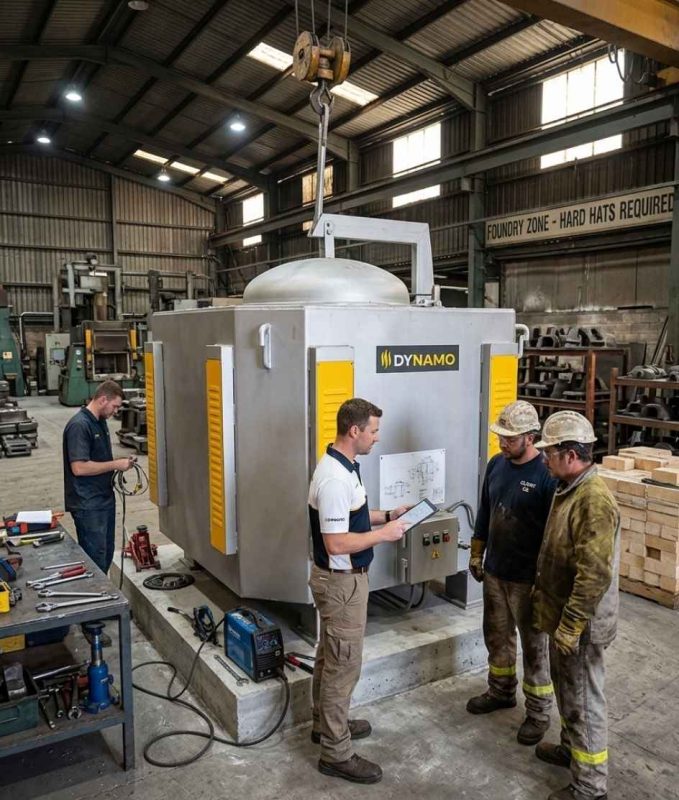
After a multi‑day transport, the furnace arrived at the customer’s aluminum casting plant in Pennsylvania. The receiving team had already prepared the installation area based on the site‑readiness checklist we provided during Phase 2.
Upon arrival, the following steps took place:
Crate inspection to confirm no transport damage
Unloading via overhead crane using designated lift points
Positioning the furnace in its final location
Staging auxiliary components such as the control panel, crucible, and spare heating rods
Our field technicians arrived on‑site the same day to begin the installation and commissioning process.
Mechanical Installation
With the furnace positioned, installation began. This stage ensures that the furnace is structurally secure, properly aligned, and ready for electrical integration.
Mechanical installation included:
Leveling the furnace base to ensure proper crucible seating
Securing anchor points to prevent vibration during operation
Installing the crucible and verifying alignment
Connecting ventilation and exhaust where required
Inspecting refractory surfaces for any transport‑related micro‑cracks
Once the mechanical setup was complete, the team moved on to electrical integration.
Electrical Integration & Control System Setup
The EM‑B‑3500’s electrical system is the heart of its performance. Our technicians worked closely with the customer’s electricians to ensure a safe and compliant installation.
This stage included:
Connecting the main power supply to the furnace’s terminal block
Grounding verification to meet UL and facility standards
Control panel mounting and cable routing
PLC and HMI configuration using pre‑loaded parameters
Heating rod resistance checks to confirm proper installation
Once all electrical connections were verified, the furnace was ready for its first on‑site power‑up.
On‑Site Commissioning
Commissioning is where the furnace transitions from a manufactured product to a functioning part of the customer’s production line. This stage is methodical, data‑driven, and essential for long‑term reliability.
Commissioning Steps
Initial power‑on and system diagnostics
Heating rod activation in controlled increments
Temperature ramp‑up to stabilize the refractory
Thermal uniformity verification using multiple sensors
Melt rate testing with aluminum charge
Holding temperature calibration for production stability
Alarm and safety system validation under real conditions
During commissioning, our technicians monitored the furnace’s performance closely, comparing on‑site data to the baseline values recorded during the Factory Acceptance Test. The EM‑B‑3500 performed exactly as expected, achieving stable melt rates and excellent thermal efficiency.
Operator Training
A furnace is only as effective as the team operating it. That’s why every installation includes a full training program tailored to the customer’s workflow.
Training covered:
Daily startup and shutdown procedures
Temperature control and setpoint management
Charging and melt‑handling best practices
Crucible care and inspection
Heating rod replacement using the side‑access design
Alarm response and troubleshooting
Preventive maintenance scheduling
Operators practiced each step directly on the furnace, ensuring they were confident and fully prepared for production.
First Production Run
With installation complete and operators trained, the final milestone was the first production run. This is the moment when the furnace transitions from a project to a working asset.
During the first melt:
The furnace reached target temperature quickly
Melt rate matched the performance recorded during FAT
Temperature stability remained within tight tolerances
Operators successfully executed charging and tapping procedures
The casting line received clean, consistent molten aluminum
The customer’s engineering team expressed confidence in the furnace’s performance and appreciated the smooth commissioning process.
Conclusion: A Successful Installation and a Strong Partnership
The completion of Phase 3 marks the end of the EM‑B‑3500’s journey from concept to production. What began as a custom engineering request has now become a fully operational melting system supporting high‑volume aluminum casting in Pennsylvania.
From design and fabrication to testing, shipment, installation, and commissioning, every step was guided by our commitment to precision, reliability, and long‑term performance.
Let Us Make Your Next Furnace
For virtually every production scenario, we have a dedicated type of melting or holding furnace. Be it a crucible furnace or a large tower melting furnace - we have a solution for you.
To experience a smooth journey from filling the information request form to having your order delivered at your factory, visit our products page.
For More Information About This Furnace
For More Information About Other Furnaces